
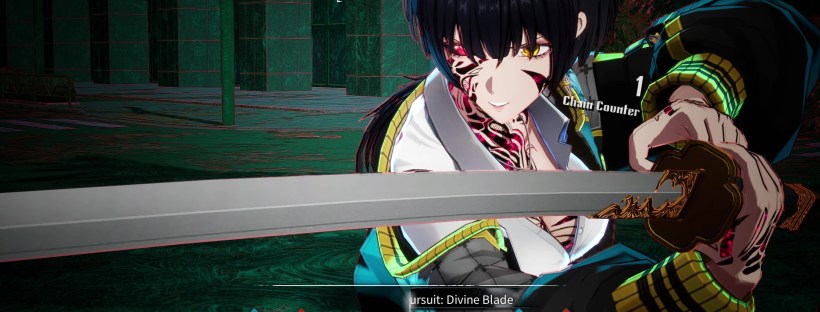
When I first sat down with Qliphah (pronounced klee-fah) on the show floor at Anime Expo 2026, I was instantly intrigued. The pitch promised a pseudo-turn-based combat system layered with rhythm-action timing. Trying to parse its intricate systems amid the chaos of the con floor proved challenging, but I convinced myself that once I settled into my cozy gaming chair at home with my handheld PC, everything would click into place.
Unfortunately, I underestimated the game and overestimated my patience.
Combat in Qliphah revolves around a constant stop-and-go tug-of-war. The core loop demands that you pause time, select an action, resume time, and attempt to bait out and counter incoming enemy strikes with precise timing. Counters are color-coded: if an enemy winds up a red attack, executing your own red ability at the exact moment of impact results in a counter.
Complications arise because damage scales primarily through combo chains executed with skills of the same color. With no standard, non-colored basic attacks available, you are frequently forced into a corner: do you spam red skills to stack combo multipliers, or abandon the sequence when the enemy cues a blue attack? Choosing to counter means the need to trigger a “skill purge”, clearing your queue to try and time the new color, all while repeatedly toggling the pause function.
While the underlying tactical premise is novel, its real-time pacing is disastrous. The constant stop-start cadence utterly drains the battle of any organic momentum or tension. Technically you can do this is “real-time” while everything moves slowly, but it isn’t quite slowly enough to give you adequate time to make your preparations.
Land a successful counter, and you knock the enemy down, earning the chance to unleash flashy special attacks. These cinematics look nice the first three times, but they quickly grow repetitive, reducing dramatic finishes to the monotony of a mobile game running on autoplay. Compounding the awkward encounter design is an unnecessary character-swapping system; both characters can be directed simultaneously, leaving camera perspective-swapping feeling entirely superfluous.
To the game’s credit, the preparation menus offer a dedicated testing space to experiment with new skill loadouts before committing to an encounter. You will want to spend substantial time there, as well as in the tutorial guide section, because the difficulty curve is unforgiving.
Qliphah thrusts players into complex multi-target skirmishes well before providing adequate onboarding. By the first multi-enemy fight, you are thrown into the deep end, struggling to track individual rhythm cues, target switches, party positioning, and the enemy’s convoluted “emotion” buff system all at once. Joy? Ennui? No thank you.
Unlocking skills with superior stats and varied timing windows requires “investigating” locations across a fractured, alternate Tokyo. While the optional lore snippets help flesh out the world, the volume of text is dense and cumbersome. More disappointing is how this system is delivered: it reduces world exploration entirely to static menu navigation.
In terms of the story and characters, the graphics and art style do a lot of the heavy lifting. The writing leaves much to be desired, frequently throwing confusing, unique to the game terminology at the player like “severance” and “Tiny True”, while frequently explaining in the most in-your-face way possible. Some visual novel scenes play out from time to time, though repeated use of the same art assets like the car scene break the immersion and make you wish for a different backdrop. Though most enemy designs are bland and forgettable, the main characters Rena and Soma are striking and attractive enough. Unfortunately, their interactions with one another and the supporting cast feel too trope-y to make them memorable or noteworthy.
It is worth noting Qliphah’s launch MSRP of $24.99. In the 2026 gaming landscape, a sub-$30 price point is undeniably accessible. However, that budget-friendly tag also reflects the title’s production compromises: recycled cutscene art, menu-driven world traversal, and an uneven difficulty curve.
Qliphah in Providence’s Shadow brings some daring combat ideas to the RPG space, but stumbles in their execution. There is a compelling tactical foundation buried beneath the stop-and-start flow, but the friction consistently outweighs the thrill. If the developers can take these lessons to heart and streamline the pacing, their next outing could be something remarkable. For now, it remains an ambitious experiment that loses its rhythm.
Disclaimer: Review copy of the game was provided for coverage. As always, my opinions are my own, no money was exchanged, and no one at the publisher saw this review prior to publication.

